
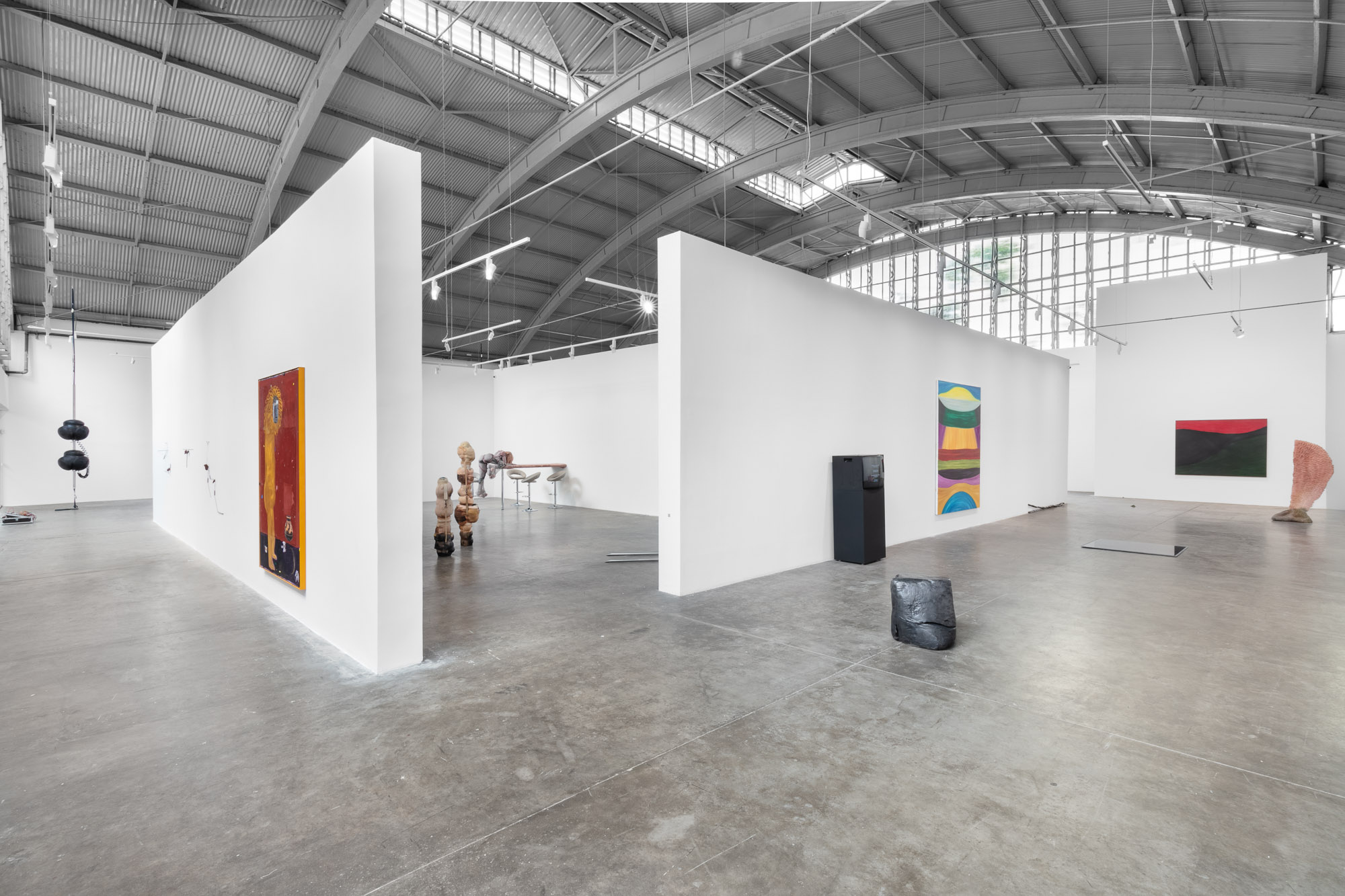
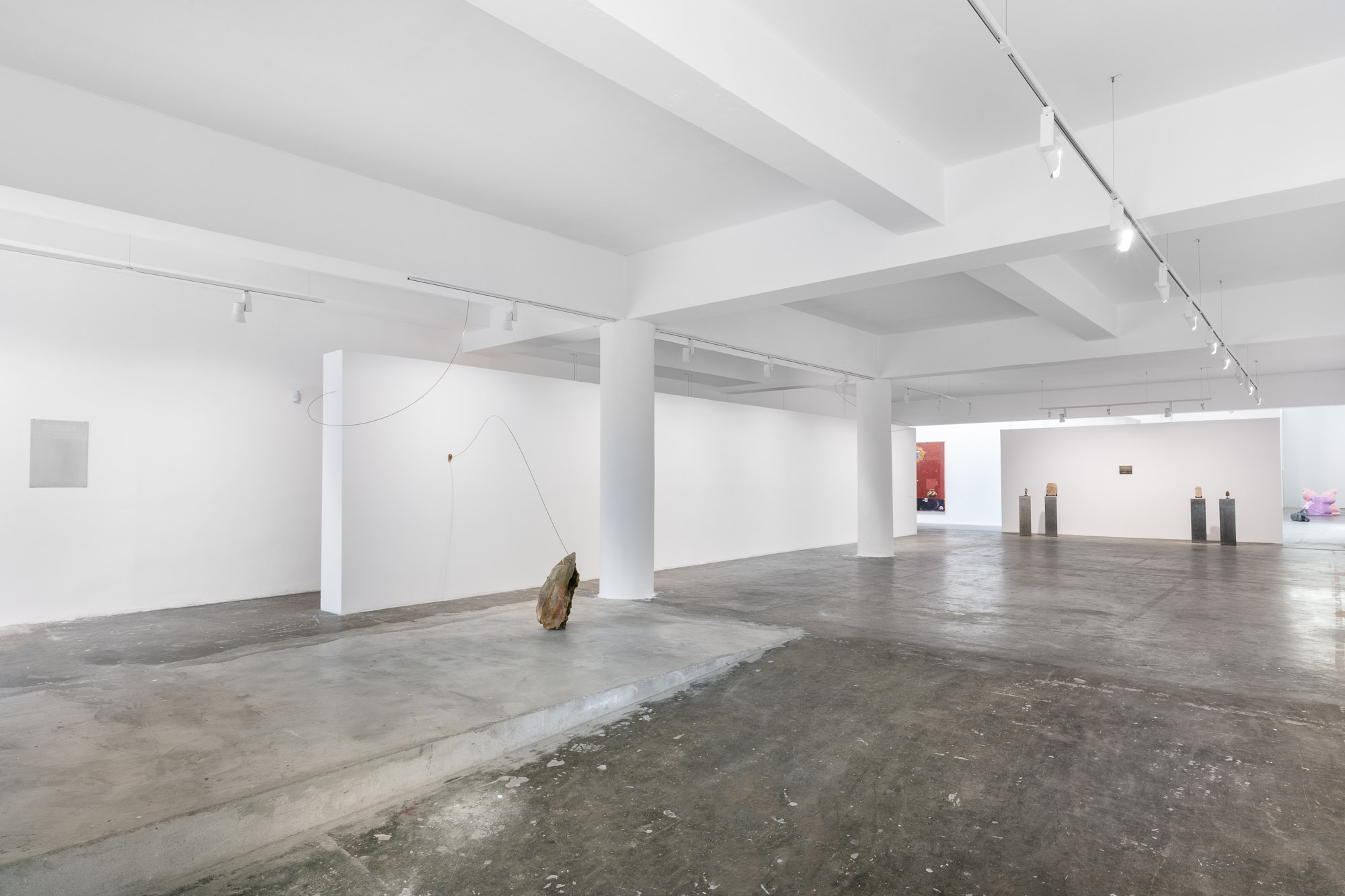
Esfíngico Frontal. Vista da exposição, Mendes Wood DM, São Paulo, 2023.
2023. Esfíngico Frontal
By observing expressions of human loneliness materialized in sphinxlike forms, “Frontal Sphinx” offers a constellation of images that reflect on how we, as humans, are haunted by our existence — and, therefore, by our solitude. The show investigates how this complex and everlasting enigma can weigh on diverse artistic productions, from the Neolithic period to twentieth-century painting and contemporary performance, through a nonlinear but penetrating arrow of time.
Addressing various systems of thought structured by humans to support their own existential issues, “Frontal Sphinx” demonstrates how they all inevitably reach a critical point regarding individuality. It is as if all paths lead to a collective existence, and any individual production that forcefully attempts to break through this membrane results in a bewildered expression. The exhibit conducts a reading of different repetitions of the same riddle, but each one rendered via its own individual concepts and visualities.
Organized and curated by Germano Dushá, the show presents fifty-nine works, by more than forty-five artists from around the world, in the ample space of Mendes Wood DM’s gallery in São Paulo. It is a culmination point in Dushá’s crescendoing curatorial practice in recent years, aligned with the Brazilian gallery’s internationalization efforts. With locations in São Paulo, Brussels, and New York, Mendes Wood DM recently announced the opening of a new space at Place des Vosges, in Paris, in July 2023.
The first space of the show is composed of an altar made with archeological relics from the fourth millennium BC to the sixteenth century AD, and a landscape painting by Lucas Arruda. They form an arc that embraces the viewer as part of a ritual: the archeological pieces, which radiate the power of time, are contrastingly exhibited on industrial steel pedestals, and, instead of a classical figurative or allegorical image in the middle of the shrine, Arruda’s painting hangs on the wall. At the same time that it praises nature as a whole, with its vast landscape, it reaffirms our human smallness, an idea also attested to by the gigantic and enigmatic temporal arcs that emanate from the archaeological pieces.
In the subsequent spaces, the invitation to the gaze — with images and beings that almost say “look at me” or “voilà mon cœur” — is inverted, just as the notion of unilateral influence was shifted by image theorists in recent times. We are not passively influenced by images, but we actively choose to engage what influences us from the platter of offerings served by our social contexts. [1] The show proves that the gaze follows the same direction: it is not directed by us, not in our full control anymore — or never was in the beginning — but some things magnetize it without our full consent, applying such a force to it that the eye becomes a passive entity. It is the image that conducts the gaze, not the other way around — as in Sphinx (2020) by Zsófia Keresztes and Paulo Monteiro’s untitled robust lead sculpture (1995).
The show highlights that contemporary and Western civilization, throughout the last centuries, is afraid to look at its own nature. And yet it sometimes does it so hyperbolically as to create hyper-realistic figures that point toward representation and not the things themselves, [2] as in Anna Uddenberg’s CLIMBER (Pierced Rosebud) (2022). There is also a notable cyborg aesthetic in many of the works in the exhibition, like Franco Palioff’s Show me your nails (2022) and Samuel Guerrero’s Flor (Flower) (2022). In Jonas Van’s Desambiguação (2021), we see gems encrusted in an orthodontic mold that remind us that we are used to the image of crooked teeth being aligned by a machine implanted in our mouths, which exerts traction against the bones for aesthetic purposes — but maybe, if we think it through, we’re not fully comfortable with the idea of it. Free arrangements of human bodies, often aligned with Hellenistic principles of beauty, are read as awkward if in bizarre positions, as in Joanna Piotrowska’s photographs (2015) of seemingly possessed subjects.
Why do we find it strange when parts of other natural species integrate with our own — like bat wings, as in Luiz Roque’s XXI (2021), or in Lynn Randolph’s Transfusions (1995) — but not so much when it comes to human-made things — like the wings of an angel, assuming that religious images are expressed only by humans, or by machines that care for your health and beauty? It not only does not bother us, but we even admire how these devices can provide ethereal moments: Roque’s video also displays a couple dancing to a music box song with one of them in a wheelchair, expressing a sense of affective connection, delicacy, and love. Why is the idea of transplanting a pig’s vein to a human body more repugnant than having your blood fully filtered by a hemodialysis machine? Opening an automaton and exposing its gears can be analogous to lacerating a body and revealing its viscera.
Technologies created by humans — in the material field, such as medicine, physics, or mechanisms of production, but also systems of beliefs and epistemological categorizations — provide us with a sense of control that protects us when facing the unknown and the uncontrollable heat of the universe. Sometimes it is presented as an other, but often it is perceived in ourselves. Our comprehension and production devices are crafted to maintain a sense of human power and control over nature. History itself is also a human technology to tame images, narratives, and events, and the mirrored relations between these entities are collapsing — as illustrated by Paulo Nimer Pjota’s Femme maison (bourgeois) (2023). As Dushá writes in the curatorial text, “the loss of this reference has been painful for humanity; time is how we quantify our attachments.” Humankind is not ready for its own loss of control.
Further along this foggy threshold between culture and nature, one of the exhibition’s questions is whether loneliness is inherent to human existence, as a physiological function of the psyche. Although creating a cohesive argument suggesting that it is visceral given, the show also deliberately presents a mirrored image that attests to the opposite: forms of natural organization that are structured from collectivity — just as some social systems are annihilated by colonialism — and that individualization is a Western cultural malaise. The sphinx itself, as an original cultural and religious entity of African peoples, was usurped by the dynamics of ancient Greek domination — as well as a huge number of African traditions and concepts that were reworked and disseminated by ancient Greece and Rome as their own [3] — conquering not only territories but dominating people and narratives in a white, individualist supremacy.
In the presumptuous human way of thinking that dominates contemporary society, contemplating the limits of the human body or the individual often involves reducing nature to the same limited perspective. This approach reflects an individualistic worldview that abstracts humans from natural categories, placing them in a position of dominance over the environment. It creates an illusion of control, as if humans were like entities who can manipulate time, images, and narrative to their will. However, the distorted and gut-wrenching images in “Frontal Sphinx” reveal the loneliness and disconnection that result from a lack of answers, whether inherited or implanted. These shared experiences remind us that we are all connected by this sense of existential uncertainty.
Notes
[1] Michael Baxandall, Patterns of Intention: On the Historical Explanation of Pictures. New Haven: Yale University Press, 1985, p. 58–59.
[2] Gilles Deleuze, The Fold: Leibniz and the Baroque. London: The Athlone Press, 1993, p. 115.
[3] Ludwig Koenen, “Greece, the Near East, and Egypt: Cyclic Destruction in Hesiod and the ‘Catalogue of Women,’” Transactions of the American Philological Association 124 (1994): p. 1–2, https://doi.org/10.2307/284283.
/
Ao observar expressões da solidão humana materializadas em formas esfíngicas, Esfíngico Frontal provê uma constelação de imagens que refletem como nós, humanos, somos assombrados por nossa própria existência - e, portanto, por nossa própria solidão. A exposição investiga como esse enigma complexo e duradouro pode interferir e guiar múltiplas produções artísticas, desde o período neolítico até a pintura do século 20 e a performance contemporânea, através de uma flexa não linear e temporalmente atravessante.
Abordando vários sistemas de pensamento estruturados por humanos para sustentar suas próprias questões existenciais, Esfíngico Frontal demonstra como todos eles inevitavelmente atingem um ponto crítico em relação à individualidade. É como se todos os caminhos conduzissem a uma existência coletiva, e qualquer produção individual que tente forçosamente romper essa membrana resulta em uma expressão caótica. A exposição conduz uma leitura de diferentes repetições de um mesmo enigma, mas cada uma representada por meio de seus conceitos e visualidades individuais.
Organizada e curada por Germano Dushá, a mostra apresenta cinquenta e nove obras de mais de quarenta e cinco artistas de todo o mundo, no amplo espaço da galeria Mendes Wood DM, em São Paulo. É o ponto culminante da crescente prática curatorial de Dushá nos últimos anos, alinhada aos esforços de internacionalização da galeria brasileira. Com sedes em São Paulo, Bruxelas e Nova York, a Mendes Wood anunciou recentemente a abertura de um novo espaço na Place des Vosges, em Paris, em julho de 2023.
O primeiro espaço da exposição é composto por um altar feito com relíquias arqueológicas do quarto milênio antes de Cristo ao século 16 e uma pintura de paisagem de Lucas Arruda. Eles formam um arco que envolve o espectador como parte de um ritual: as peças arqueológicas, que irradiam o poder do tempo, são exibidas contrastantemente em pedestais de aço industrial e, onde se encontraria uma imagem figurativa ou alegórica clássica no meio desse santuário, o quadro de Arruda está pendurado na parede. Ao mesmo tempo que louva a natureza como um todo, em sua vasta paisagem, reafirma a pequenez humana, ideia também reiterada pelos gigantescos e enigmáticos arcos temporais que emanam das peças arqueológicas.
Nos espaços subsequentes, o convite ao olhar — com imagens e seres que quase dizem “olhe para mim” ou “voilà mon cœur” — se inverte, assim como a noção de influência unilateral foi deslocada pelos teóricos da imagem nos últimos tempos. Não somos influenciados passivamente por imagens, mas escolhemos ativamente operar o que nos influencia a partir do prato de oferendas servido por nossos contextos sociais [1]. A exposição prova que o olhar segue a mesma direção: não é direcionado por nós, não mais em nosso controle total—- ou nunca foi desde o começo —, mas algumas coisas o magnetizam sem nosso total consentimento, aplicando uma força tão forte que o olho se torna uma entidade passiva. É a imagem que conduz o olhar, e não o contrário — como em Sphinx (2020) de Zsófia Keresztes e na robusta escultura em chumbo sem título de Paulo Monteiro (1995).
A mostra evidencia que a civilização contemporânea ocidental, ao longo dos últimos séculos, tem medo de olhar para sua própria natureza. E, por vezes, o faz de forma tão hiperbólica que cria figuras hiper-realistas que apontam para a representação e não para as coisas em si [2], como em CLIMBER (Pierced Rosebud) de Anna Uddenberg (2022). Há também uma notável estética ciborgue em muitas das obras da exposição, como em Show me your nails (2022), de Franco Palioff, e Flor (Flower) (2022), de Samuel Guerrero. Em Desambiguação (2021), de Jonas Van, vemos gemas incrustadas em um molde ortodôntico que nos lembram que estamos acostumados com a imagem de dentes tortos sendo alinhados por uma máquina implantada em nossa boca, que exerce tração contra os ossos para fins estéticos — mas, talvez, se pensarmos bem, não nos sintamos totalmente à vontade com a ideia. Arranjos livres de corpos humanos, muitas vezes alinhados com princípios helenísticos de beleza, são lidos como estranhos se em posições bizarras, como nas fotografias de Joanna Piotrowska (2015) de pessoas que parecem estar possuídas.
Por que estranhamos quando partes de outras espécies naturais se integram às nossas — como asas de morcego, como em XXI (2021), de Luiz Roque, ou em Transfusions (1995), de Lynn Randolph —, mas nem tanto quando se trata de coisas humanamente produzidas — como as asas de um anjo, assumindo que as imagens religiosas são expressas apenas por humanos, ou por máquinas que cuidam de sua saúde e beleza? Não só não nos incomoda, como até admiramos como esses aparelhos podem proporcionar momentos etéreos: o vídeo de Roque também mostra um casal dançando ao som de uma caixa de música com um deles em uma cadeira de rodas, expressando uma sensação de conexão afetiva, delicadeza e amor. Por que a ideia de transplantar uma veia de porco em um corpo humano é mais repugnante do que ter seu sangue totalmente filtrado por uma máquina de hemodiálise? Abrir um autômato e expor suas engrenagens pode ser análogo a dilacerar um corpo e revelar suas vísceras.
As tecnologias criadas pelo homem — no campo material, como a medicina, a física ou os mecanismos de produção, mas também sistemas de crenças e categorizações epistemológicas — nos fornecem um senso de controle que nos protege diante do desconhecido e do calor incontrolável do universo. Às vezes, se transpõe ao outro, mas muitas vezes é percebido em nós mesmos. Nossos dispositivos de compreensão e produção são criados para manter um senso de poder humano e controle sobre a natureza. A própria história é também uma tecnologia humana para domar imagens, narrativas e eventos, e as relações espelhadas entre essas entidades estão entrando em colapso — como ilustra Femme maison (bourgeois) (2023) de Paulo Nimer Pjota. Como escreve Dushá no texto curatorial, “a perda dessa referência tem sido dolorosa para a humanidade; o tempo é como quantificamos nossos apegos.” A humanidade não está pronta para sua própria perda de controle.
Mais adiante nesse nebuloso limiar entre cultura e natureza, uma das questões da exposição é se a solidão é inerente à existência humana, como função fisiológica da psique. Embora crie um argumento coeso sugerindo que é um aspecto visceral, a mostra também apresenta deliberadamente uma imagem espelhada que atesta o contrário: formas de organização natural que se estruturam a partir da coletividade — assim como alguns sistemas sociais são aniquilados pelo colonialismo — e que a individualização é um mal-estar cultural ocidental. A própria esfinge, como entidade cultural e religiosa original dos povos africanos, foi usurpada pela dinâmica da antiga dominação grega — assim como por um grande número de tradições e conceitos africanos que foram reelaborados e difundidos pela Grécia e Roma antigas como seus [3] — conquistando não apenas territórios, mas dominando pessoas e narrativas em uma supremacia branca e individualista.
No presunçoso modo de pensar humano que domina a sociedade contemporânea, contemplar os limites do corpo humano ou do indivíduo envolve muitas vezes reduzir a natureza a uma mesma perspectiva limitada. Essa abordagem reflete uma visão de mundo individualista que abstrai os seres humanos das categorias naturais, colocando-os em uma posição de domínio sobre o meio ambiente. Cria uma ilusão de controle, como se os humanos fossem como entidades que podem manipular o tempo, as imagens e a narrativa à sua vontade. No entanto, as imagens distorcidas e angustiantes em Esfíngico Frontal revelam a solidão e a desconexão que resultam da falta de respostas, herdadas ou implantadas. Essas experiências compartilhadas nos lembram que estamos todos conectados por esse sentimento de incerteza existencial.
Notas
[1] Michael Baxandall, Patterns of Intention: On the Historical Explanation of Pictures. New Haven: Yale University Press, 1985, p. 58–59.
[2] Gilles Deleuze, The Fold: Leibniz and the Baroque. London: The Athlone Press, 1993, p. 115.
[3] Ludwig Koenen, “Greece, the Near East, and Egypt: Cyclic Destruction in Hesiod and the ‘Catalogue of Women,’” Transactions of the American Philological Association 124 (1994): p. 1–2, https://doi.org/10.2307/284283.
Texto originalmente publicado em inglês na Flash Art Magazine, em 3 de março de 2023
Addressing various systems of thought structured by humans to support their own existential issues, “Frontal Sphinx” demonstrates how they all inevitably reach a critical point regarding individuality. It is as if all paths lead to a collective existence, and any individual production that forcefully attempts to break through this membrane results in a bewildered expression. The exhibit conducts a reading of different repetitions of the same riddle, but each one rendered via its own individual concepts and visualities.
Organized and curated by Germano Dushá, the show presents fifty-nine works, by more than forty-five artists from around the world, in the ample space of Mendes Wood DM’s gallery in São Paulo. It is a culmination point in Dushá’s crescendoing curatorial practice in recent years, aligned with the Brazilian gallery’s internationalization efforts. With locations in São Paulo, Brussels, and New York, Mendes Wood DM recently announced the opening of a new space at Place des Vosges, in Paris, in July 2023.
The first space of the show is composed of an altar made with archeological relics from the fourth millennium BC to the sixteenth century AD, and a landscape painting by Lucas Arruda. They form an arc that embraces the viewer as part of a ritual: the archeological pieces, which radiate the power of time, are contrastingly exhibited on industrial steel pedestals, and, instead of a classical figurative or allegorical image in the middle of the shrine, Arruda’s painting hangs on the wall. At the same time that it praises nature as a whole, with its vast landscape, it reaffirms our human smallness, an idea also attested to by the gigantic and enigmatic temporal arcs that emanate from the archaeological pieces.
In the subsequent spaces, the invitation to the gaze — with images and beings that almost say “look at me” or “voilà mon cœur” — is inverted, just as the notion of unilateral influence was shifted by image theorists in recent times. We are not passively influenced by images, but we actively choose to engage what influences us from the platter of offerings served by our social contexts. [1] The show proves that the gaze follows the same direction: it is not directed by us, not in our full control anymore — or never was in the beginning — but some things magnetize it without our full consent, applying such a force to it that the eye becomes a passive entity. It is the image that conducts the gaze, not the other way around — as in Sphinx (2020) by Zsófia Keresztes and Paulo Monteiro’s untitled robust lead sculpture (1995).
The show highlights that contemporary and Western civilization, throughout the last centuries, is afraid to look at its own nature. And yet it sometimes does it so hyperbolically as to create hyper-realistic figures that point toward representation and not the things themselves, [2] as in Anna Uddenberg’s CLIMBER (Pierced Rosebud) (2022). There is also a notable cyborg aesthetic in many of the works in the exhibition, like Franco Palioff’s Show me your nails (2022) and Samuel Guerrero’s Flor (Flower) (2022). In Jonas Van’s Desambiguação (2021), we see gems encrusted in an orthodontic mold that remind us that we are used to the image of crooked teeth being aligned by a machine implanted in our mouths, which exerts traction against the bones for aesthetic purposes — but maybe, if we think it through, we’re not fully comfortable with the idea of it. Free arrangements of human bodies, often aligned with Hellenistic principles of beauty, are read as awkward if in bizarre positions, as in Joanna Piotrowska’s photographs (2015) of seemingly possessed subjects.
Why do we find it strange when parts of other natural species integrate with our own — like bat wings, as in Luiz Roque’s XXI (2021), or in Lynn Randolph’s Transfusions (1995) — but not so much when it comes to human-made things — like the wings of an angel, assuming that religious images are expressed only by humans, or by machines that care for your health and beauty? It not only does not bother us, but we even admire how these devices can provide ethereal moments: Roque’s video also displays a couple dancing to a music box song with one of them in a wheelchair, expressing a sense of affective connection, delicacy, and love. Why is the idea of transplanting a pig’s vein to a human body more repugnant than having your blood fully filtered by a hemodialysis machine? Opening an automaton and exposing its gears can be analogous to lacerating a body and revealing its viscera.
Technologies created by humans — in the material field, such as medicine, physics, or mechanisms of production, but also systems of beliefs and epistemological categorizations — provide us with a sense of control that protects us when facing the unknown and the uncontrollable heat of the universe. Sometimes it is presented as an other, but often it is perceived in ourselves. Our comprehension and production devices are crafted to maintain a sense of human power and control over nature. History itself is also a human technology to tame images, narratives, and events, and the mirrored relations between these entities are collapsing — as illustrated by Paulo Nimer Pjota’s Femme maison (bourgeois) (2023). As Dushá writes in the curatorial text, “the loss of this reference has been painful for humanity; time is how we quantify our attachments.” Humankind is not ready for its own loss of control.
Further along this foggy threshold between culture and nature, one of the exhibition’s questions is whether loneliness is inherent to human existence, as a physiological function of the psyche. Although creating a cohesive argument suggesting that it is visceral given, the show also deliberately presents a mirrored image that attests to the opposite: forms of natural organization that are structured from collectivity — just as some social systems are annihilated by colonialism — and that individualization is a Western cultural malaise. The sphinx itself, as an original cultural and religious entity of African peoples, was usurped by the dynamics of ancient Greek domination — as well as a huge number of African traditions and concepts that were reworked and disseminated by ancient Greece and Rome as their own [3] — conquering not only territories but dominating people and narratives in a white, individualist supremacy.
In the presumptuous human way of thinking that dominates contemporary society, contemplating the limits of the human body or the individual often involves reducing nature to the same limited perspective. This approach reflects an individualistic worldview that abstracts humans from natural categories, placing them in a position of dominance over the environment. It creates an illusion of control, as if humans were like entities who can manipulate time, images, and narrative to their will. However, the distorted and gut-wrenching images in “Frontal Sphinx” reveal the loneliness and disconnection that result from a lack of answers, whether inherited or implanted. These shared experiences remind us that we are all connected by this sense of existential uncertainty.
Notes
[1] Michael Baxandall, Patterns of Intention: On the Historical Explanation of Pictures. New Haven: Yale University Press, 1985, p. 58–59.
[2] Gilles Deleuze, The Fold: Leibniz and the Baroque. London: The Athlone Press, 1993, p. 115.
[3] Ludwig Koenen, “Greece, the Near East, and Egypt: Cyclic Destruction in Hesiod and the ‘Catalogue of Women,’” Transactions of the American Philological Association 124 (1994): p. 1–2, https://doi.org/10.2307/284283.
/
Ao observar expressões da solidão humana materializadas em formas esfíngicas, Esfíngico Frontal provê uma constelação de imagens que refletem como nós, humanos, somos assombrados por nossa própria existência - e, portanto, por nossa própria solidão. A exposição investiga como esse enigma complexo e duradouro pode interferir e guiar múltiplas produções artísticas, desde o período neolítico até a pintura do século 20 e a performance contemporânea, através de uma flexa não linear e temporalmente atravessante.
Abordando vários sistemas de pensamento estruturados por humanos para sustentar suas próprias questões existenciais, Esfíngico Frontal demonstra como todos eles inevitavelmente atingem um ponto crítico em relação à individualidade. É como se todos os caminhos conduzissem a uma existência coletiva, e qualquer produção individual que tente forçosamente romper essa membrana resulta em uma expressão caótica. A exposição conduz uma leitura de diferentes repetições de um mesmo enigma, mas cada uma representada por meio de seus conceitos e visualidades individuais.
Organizada e curada por Germano Dushá, a mostra apresenta cinquenta e nove obras de mais de quarenta e cinco artistas de todo o mundo, no amplo espaço da galeria Mendes Wood DM, em São Paulo. É o ponto culminante da crescente prática curatorial de Dushá nos últimos anos, alinhada aos esforços de internacionalização da galeria brasileira. Com sedes em São Paulo, Bruxelas e Nova York, a Mendes Wood anunciou recentemente a abertura de um novo espaço na Place des Vosges, em Paris, em julho de 2023.
O primeiro espaço da exposição é composto por um altar feito com relíquias arqueológicas do quarto milênio antes de Cristo ao século 16 e uma pintura de paisagem de Lucas Arruda. Eles formam um arco que envolve o espectador como parte de um ritual: as peças arqueológicas, que irradiam o poder do tempo, são exibidas contrastantemente em pedestais de aço industrial e, onde se encontraria uma imagem figurativa ou alegórica clássica no meio desse santuário, o quadro de Arruda está pendurado na parede. Ao mesmo tempo que louva a natureza como um todo, em sua vasta paisagem, reafirma a pequenez humana, ideia também reiterada pelos gigantescos e enigmáticos arcos temporais que emanam das peças arqueológicas.
Nos espaços subsequentes, o convite ao olhar — com imagens e seres que quase dizem “olhe para mim” ou “voilà mon cœur” — se inverte, assim como a noção de influência unilateral foi deslocada pelos teóricos da imagem nos últimos tempos. Não somos influenciados passivamente por imagens, mas escolhemos ativamente operar o que nos influencia a partir do prato de oferendas servido por nossos contextos sociais [1]. A exposição prova que o olhar segue a mesma direção: não é direcionado por nós, não mais em nosso controle total—- ou nunca foi desde o começo —, mas algumas coisas o magnetizam sem nosso total consentimento, aplicando uma força tão forte que o olho se torna uma entidade passiva. É a imagem que conduz o olhar, e não o contrário — como em Sphinx (2020) de Zsófia Keresztes e na robusta escultura em chumbo sem título de Paulo Monteiro (1995).
A mostra evidencia que a civilização contemporânea ocidental, ao longo dos últimos séculos, tem medo de olhar para sua própria natureza. E, por vezes, o faz de forma tão hiperbólica que cria figuras hiper-realistas que apontam para a representação e não para as coisas em si [2], como em CLIMBER (Pierced Rosebud) de Anna Uddenberg (2022). Há também uma notável estética ciborgue em muitas das obras da exposição, como em Show me your nails (2022), de Franco Palioff, e Flor (Flower) (2022), de Samuel Guerrero. Em Desambiguação (2021), de Jonas Van, vemos gemas incrustadas em um molde ortodôntico que nos lembram que estamos acostumados com a imagem de dentes tortos sendo alinhados por uma máquina implantada em nossa boca, que exerce tração contra os ossos para fins estéticos — mas, talvez, se pensarmos bem, não nos sintamos totalmente à vontade com a ideia. Arranjos livres de corpos humanos, muitas vezes alinhados com princípios helenísticos de beleza, são lidos como estranhos se em posições bizarras, como nas fotografias de Joanna Piotrowska (2015) de pessoas que parecem estar possuídas.
Por que estranhamos quando partes de outras espécies naturais se integram às nossas — como asas de morcego, como em XXI (2021), de Luiz Roque, ou em Transfusions (1995), de Lynn Randolph —, mas nem tanto quando se trata de coisas humanamente produzidas — como as asas de um anjo, assumindo que as imagens religiosas são expressas apenas por humanos, ou por máquinas que cuidam de sua saúde e beleza? Não só não nos incomoda, como até admiramos como esses aparelhos podem proporcionar momentos etéreos: o vídeo de Roque também mostra um casal dançando ao som de uma caixa de música com um deles em uma cadeira de rodas, expressando uma sensação de conexão afetiva, delicadeza e amor. Por que a ideia de transplantar uma veia de porco em um corpo humano é mais repugnante do que ter seu sangue totalmente filtrado por uma máquina de hemodiálise? Abrir um autômato e expor suas engrenagens pode ser análogo a dilacerar um corpo e revelar suas vísceras.
As tecnologias criadas pelo homem — no campo material, como a medicina, a física ou os mecanismos de produção, mas também sistemas de crenças e categorizações epistemológicas — nos fornecem um senso de controle que nos protege diante do desconhecido e do calor incontrolável do universo. Às vezes, se transpõe ao outro, mas muitas vezes é percebido em nós mesmos. Nossos dispositivos de compreensão e produção são criados para manter um senso de poder humano e controle sobre a natureza. A própria história é também uma tecnologia humana para domar imagens, narrativas e eventos, e as relações espelhadas entre essas entidades estão entrando em colapso — como ilustra Femme maison (bourgeois) (2023) de Paulo Nimer Pjota. Como escreve Dushá no texto curatorial, “a perda dessa referência tem sido dolorosa para a humanidade; o tempo é como quantificamos nossos apegos.” A humanidade não está pronta para sua própria perda de controle.
Mais adiante nesse nebuloso limiar entre cultura e natureza, uma das questões da exposição é se a solidão é inerente à existência humana, como função fisiológica da psique. Embora crie um argumento coeso sugerindo que é um aspecto visceral, a mostra também apresenta deliberadamente uma imagem espelhada que atesta o contrário: formas de organização natural que se estruturam a partir da coletividade — assim como alguns sistemas sociais são aniquilados pelo colonialismo — e que a individualização é um mal-estar cultural ocidental. A própria esfinge, como entidade cultural e religiosa original dos povos africanos, foi usurpada pela dinâmica da antiga dominação grega — assim como por um grande número de tradições e conceitos africanos que foram reelaborados e difundidos pela Grécia e Roma antigas como seus [3] — conquistando não apenas territórios, mas dominando pessoas e narrativas em uma supremacia branca e individualista.
No presunçoso modo de pensar humano que domina a sociedade contemporânea, contemplar os limites do corpo humano ou do indivíduo envolve muitas vezes reduzir a natureza a uma mesma perspectiva limitada. Essa abordagem reflete uma visão de mundo individualista que abstrai os seres humanos das categorias naturais, colocando-os em uma posição de domínio sobre o meio ambiente. Cria uma ilusão de controle, como se os humanos fossem como entidades que podem manipular o tempo, as imagens e a narrativa à sua vontade. No entanto, as imagens distorcidas e angustiantes em Esfíngico Frontal revelam a solidão e a desconexão que resultam da falta de respostas, herdadas ou implantadas. Essas experiências compartilhadas nos lembram que estamos todos conectados por esse sentimento de incerteza existencial.
Notas
[1] Michael Baxandall, Patterns of Intention: On the Historical Explanation of Pictures. New Haven: Yale University Press, 1985, p. 58–59.
[2] Gilles Deleuze, The Fold: Leibniz and the Baroque. London: The Athlone Press, 1993, p. 115.
[3] Ludwig Koenen, “Greece, the Near East, and Egypt: Cyclic Destruction in Hesiod and the ‘Catalogue of Women,’” Transactions of the American Philological Association 124 (1994): p. 1–2, https://doi.org/10.2307/284283.
Texto originalmente publicado em inglês na Flash Art Magazine, em 3 de março de 2023



Todas as imagens são cortesia da galeria Mendes Wood DM, São Paulo, Bruxelas e Nova York.